Expression Under Load
Why performance, movement, and confidence change under pressure, and how they can be trained
Introduction
Many athletes of all abilities appear capable in training, practice, or calm environments, yet they struggle when things become harder.
This might show up as:
- movement breaking down when tired
- pain or tightness appearing under effort
- confidence dropping in competition
- coordination disappearing under pressure
- skills not “showing up” on the day
This is often confusing and frustrating – especially when scans, strength tests, or fitness levels suggest nothing is “wrong”.
The idea of Expression Under Load helps explain why this happens, and what can be done about it.
Capacity vs Expression (in simple terms)
There are two different things at play in performance and movement:
Capacity
This is what someone can do in ideal conditions:
- strength
- fitness
- mobility
- skill
- knowledge
Expression
This is what actually shows up when conditions are harder:
- fatigue
- pressure
- pain
- uncertainty
- competition
- emotional stress
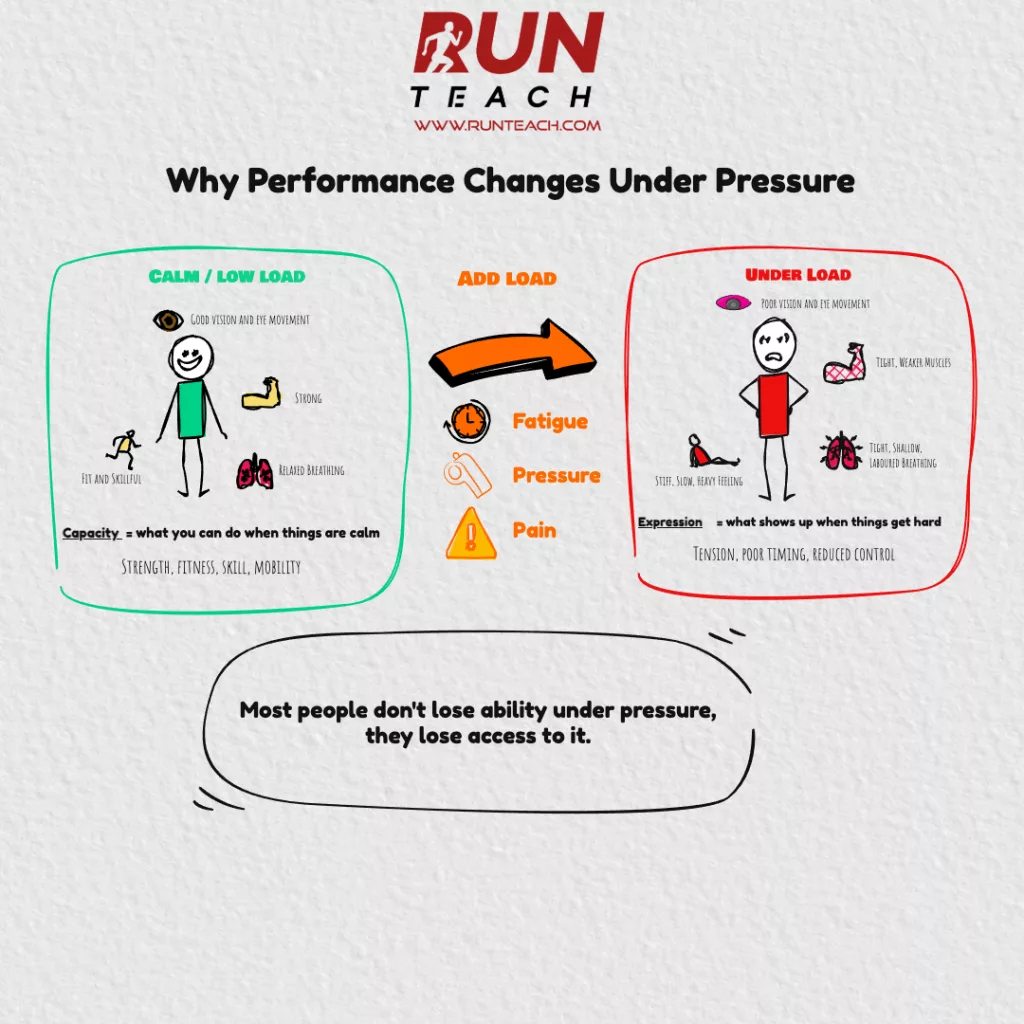
Most people spend a lot of time building capacity – very few train expression.
Why things fall apart under load
When effort increases or situations become stressful, the nervous system’s first job is protection, not performance.
If the system perceives threat – even subtle threat – it may respond by:
- increasing muscle tension
- limiting movement options
- simplifying coordination
- altering breathing
- narrowing attention
This is not a failure.
It is a protective response, and it can look like:
- sudden stiffness
- awkward movement
- pain that appears “out of nowhere”
- loss of confidence
- inconsistent performance
Importantly, this does not mean you are weak, broken, or injured.
It means your system is doing what it thinks is safest under load.
A key misunderstanding
A common assumption is:
“If performance drops, you must need more strength, fitness, or discipline.”
Sometimes that helps.
Often, it doesn’t.
Many athletes already have the required capacity – but lose access to it when things get hard.
This is why:
- performance can look great in practice but not in competition
- scans and tests can be “normal” while symptoms persist
- pushing harder can sometimes make things worse
The issue isn’t effort.
It’s how the system behaves under load.
What “Expression Under Load” means
Expression Under Load is the skill of maintaining access to movement quality, coordination, and control when conditions are not ideal.
In simple terms, it means:
- staying organised when tired
- staying fluid when pressure rises
- staying coordinated when effort increases
- staying confident when things feel uncertain
This skill is trainable.
How this is trained (without force or pushing)
Training expression under load does not mean pushing through pain or stress.
Instead, it involves:
- starting with movements the person already does well
- introducing small, controlled challenges (fatigue, balance, pace, attention)
- maintaining quality while load increases slightly
- helping the nervous system learn that it is safe to stay organised
Over time, this reduces unnecessary protective responses and improves reliability under pressure. The emphasis is always on:
- safety
- control
- gradual exposure
- confidence
Why this matters for children and teenagers
Young people are still developing:
- physically
- emotionally
- neurologically
Their systems are often more sensitive to:
- pressure
- expectations
- growth spurts
- uncertainty
When expression under load isn’t addressed, this can lead to:
- recurring niggles
- avoidance of activity
- loss of confidence
- early dropout from sport
By training how the system behaves under load, we help young people:
- move with more confidence
- reduce fear around effort
- stay involved in activity
- trust their bodies again
Why this matters for every athlete
No matter what age or level of sporting maturity you are at right now, many of the same outcomes from expression under load can apply to you:
- recurring niggles
- avoidance of activity
- loss of confidence
- loss of mojo and quitting your sport
But training how your systems behave under these conditions, and making it as sport specific as we can, we can help you in the same ways:
- move with more confidence
- reduce your fear around effort
- stay involved in the sport you love
- trust your body again
This is not about “fixing” anyone
An important point:
This work is not about correcting faults or fixing broken bodies.
It is about:
- understanding how the systems respond to challenge
- improving access to existing abilities
- supporting resilience and adaptability
Many people already have what they need.
They just need help expressing it more reliably.
In summary
- Capacity is what someone can do in ideal conditions
- Expression is what shows up under fatigue, pressure, or stress
- Many movement and performance problems come from loss of expression, not lack of capacity
- Expression under load is a trainable skill
Training it improves performance, confidence, and resilience
A final thought for parents
If your child or teenager:
- looks capable but inconsistent
- struggles under pressure
- experiences recurring pain without clear injury
- loses confidence when things get hard
It doesn’t mean they are weak, lazy, or broken.
It often means their system needs help learning how to stay organised under load.
That is what this work supports.